
Shift scheduling guide
Rotating Shift Schedules: Examples and Templates
Learn how rotating shift schedules work and compare practical 2-2-3, Pitman, DuPont, 8-, 10-, and 12-hour rotation examples.
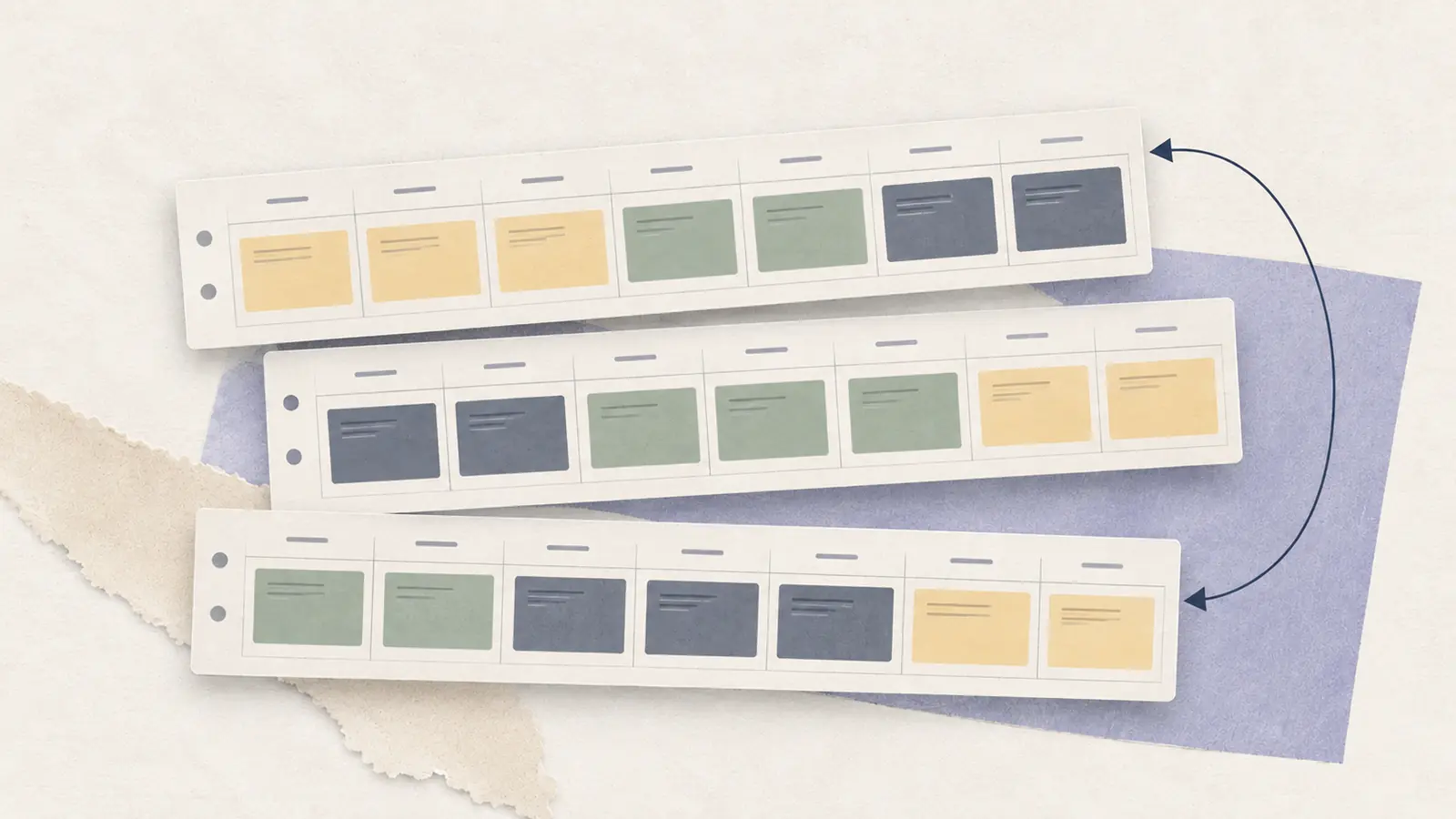
A hospital, manufacturing site, or security team may need shift coverage every day, including nights and weekends. Rotating shift schedules allow employees to take different work periods over a repeating cycle. Before adopting a named pattern, managers need to prove it covers the operation’s actual hours with the available qualified teams. That is a core part of shift scheduling.
Quick answer: A rotating shift schedule is a repeatable pattern in which employees change assigned shifts or work periods across days or weeks. A fixed schedule keeps those assignments largely consistent. Rotations may help spread difficult shifts, but they need enough teams, break coverage, and time between assignments.
What Is a Rotating Shift Schedule?
Rotating schedules specify an entire cycle of work, nights, rest days, and handoffs. In a basic weekly rotation, one employee works 6 a.m. to 2 p.m. for a week, then 2 p.m. to 10 p.m. the following week. In continuous operations, multiple teams can alternate 12-hour day and night coverage using a 14-day or 28-day cycle.
A pattern name does not say how many employees are on each team, which qualifications they carry, or whether absence relief is available. Those must be planned separately. For other structures, see work schedule types. For variable demand, first estimate necessary coverage using workforce forecasting.
How to Check Whether a Rotation Can Work
1. Define the coverage window. A 24/7 site needs 168 operating hours every seven days per continuously staffed position. With 12-hour shifts, that is 14 shifts weekly. Two simultaneous positions require 28 shifts.
2. Calculate scheduled demand. Multiply required concurrent staffed positions by hours of coverage. Divide by shift length to obtain total shift slots. This is coverage arithmetic, before breaks, sickness, training, or overlap.
3. Specify qualified teams. For four teams sharing a single continuous 12-hour post, the baseline averages 168 ÷ 4 = 42 scheduled hours per team weekly across the full rotation. This is an average, not a promise of 42 paid hours every week.
4. Check transitions. Track each start and end time on a real timeline, including overnight shifts crossing midnight. A day shift immediately following a night shift can create an unacceptable recovery gap.
5. Check the whole cycle. Count exactly one day and one night assignment per calendar day for a single 24/7 post. Look for overtime exposure, long work stretches, role coverage, and insufficient spare capacity.
6. Check applicable requirements. Labor law, collective bargaining agreements, company policies, fatigue risks, and any industry-specific safety rules can affect the design. Mathematical coverage alone never establishes compliance.
Rotating Shift Schedule Examples
The following examples are original, hypothetical coverage designs. They illustrate how patterns repeat. Each example needs local validation before use as a real employee schedule.
Example 1: Two-team alternating early and late shifts
Assume one qualified person is needed during a 16-hour window, Monday through Friday, divided into E = 6 a.m.–2 p.m. and L = 2 p.m.–10 p.m. Team A covers E in Week 1 and L in Week 2. Team B covers L in Week 1 and E in Week 2. Each works five eight-hour shifts weekly. The ten slots total 80 hours of required coverage; the pattern supplies exactly 80 hours with no absence or break relief.
Example 2: Four-team continuous 12-hour rotation
Assume one continuously staffed position, D = 7 a.m.–7 p.m., N = 7 p.m.–7 a.m., and O = off. There are 56 twelve-hour shift slots over 28 days. Four teams each work 14 shifts (168 hours) over the 28-day cycle. The grid below has exactly one D and one N every calendar day and separates each team’s day and night blocks with off days.
2-2-3 Schedule
Weekly-hour check: In the particular seven-work-shifts-per-14-days example below, a crew works 60 scheduled hours in one seven-day week (five 12-hour shifts) and 24 in the other (two 12-hour shifts). The average is 42 hours per week across the full cycle. The heavy week should be checked against the applicable workweek overtime rules and fatigue controls.
A 2-2-3 is a two-week rhythm of two workdays, two days off, three workdays, then an opposite sequence the following week. In its common 12-hour, four-team 24/7 arrangement, two complementary teams cover day shifts and two cover night shifts. Each team works seven shifts per 14 days, an average of 42 hours weekly. A label such as 2-2-3 does not prove that an individual team rotates between days and nights every two weeks; some implementations keep day/night assignments fixed until a separately planned switch.
For one illustrative day-shift team, a two-week sequence is DDOO DDD | OODD OOO, with spaces added only for readability. Its complementary day team works the opposite seven positions; an equivalent pair fills the night shifts. This 14-day coverage cycle can be repeated or used as one phase of a longer day-to-night rotation. Any switch needs off-duty transition time.
Pitman Schedule
The Pitman schedule is commonly described as a four-crew variation of the 2-2-3 arrangement, often using twelve-hour shifts and alternating long and short workweeks. Because vendors and employers apply these names inconsistently, compare the actual 14- or 28-day grids. For a basic 14-day Pitman-style cycle, the day crew pattern above, its complement, and matching night crews cover all 28 twelve-hour slots without gaps. That arrangement alone leaves each team at a fixed time of day unless a longer day/night switch is added.
When introducing a rotating Pitman version, publish the entire longer cycle and verify the changeover from day to night assignments. Do not rotate crew labels across the existing grid without recalculating rest intervals and coverage.
DuPont Schedule
Weekly-hour check: Each crew works 48, 72, 48, and 0 scheduled hours across the four calendar weeks in some order. Its average is 42 hours a week, but the 72-hour week is a material workload and overtime exposure. A four-week average must not replace individual-workweek overtime assessment.
DuPont is a distinct 28-day four-team, 12-hour pattern widely described through work blocks and a seven-day break. The original example below uses the cycle NNNN OOO DDD O NNN OOO DDDD OOOOOOO for Team A, with the three other teams offset by seven, 14, and 21 days. The four teams together provide exactly one D and one N on each of 28 days. The four-week total is 14 shifts per team, or 168 scheduled hours.
The seven-day break is visible in the example, but other weeks may be intensive. Confirm which hours count as the beginning of an overnight shift and which day an ending overnight shift releases the employee. Overnight work can affect sleep, and an apparently long calendar gap may partly include recovery from a night assignment.
Verified 28-day DuPont-style team grid
D = 7 a.m.–7 p.m.; N = 7 p.m.–7 a.m.; O = off. Each seven-character block is one consecutive week; the first letter corresponds to Day 1. These are shift start dates. Overnight assignments end the following day.
Team A: NNNNOOO | DDDONNN | OOODDDD | OOOOOOO
Team B: OOOOOOO | NNNNOOO | DDDONNN | OOODDDD
Team C: OOODDDD | OOOOOOO | NNNNOOO | DDDONNN
Team D: DDDONNN | OOODDDD | OOOOOOO | NNNNOOO
Coverage check: Every one of the 28 days has exactly one day crew and one night crew. Each crew has seven D shifts, seven N shifts, and 14 off days. This model assumes one person or one fully qualified crew is available for every assigned shift. It has no explicit sickness, vacation, or break-relief capacity.
Weekly scheduled hours in the verified 28-day example
| Crew | Week 1 | Week 2 | Week 3 | Week 4 | Four-week total |
|---|---|---|---|---|---|
| A | 48 | 72 | 48 | 0 | 168 |
| B | 0 | 48 | 72 | 48 | 168 |
| C | 48 | 0 | 48 | 72 | 168 |
| D | 72 | 48 | 0 | 48 | 168 |
All values are scheduled hours based on shift start dates. This table is an operational demonstration. It has no coverage for planned leave, unexpected absences, breaks, or overlap and is not legal or fatigue approval.
INTERACTIVE ROTATION
Explore a 28-day shift rotation
Compare two common four-team rotations for 24/7 cover. See each team’s weeks at a glance and download the day-by-day pattern.
D = day; N = night; O = off.
4-week view
These are examples with one fully qualified team on each 12-hour shift. They do not include cover for breaks or time off, individual skills, or legal approval.
How the schedule is counted
Each D or N is a 12-hour shift. Four teams cover days and nights for all 28 days. Weekly hours are added up for each team, week by week. This shows who works when. It is not advice on staffing levels or safe working hours.
12-Hour Rotating Shift Schedule Template
To adapt the 28-day grid, define the required number of positions on day and night shifts, choose the team size for each assigned crew, and fill any qualification differences within those teams. Multiply crew assignments by qualified headcount to calculate true staffing requirements. Preserve the exact cycle until a change has been validated across all dates and teams.
If a post needs two workers at all times, the 56 shift slots still exist for each person-role assignment, but two qualified workers must staff each occupied block. Four ‘teams’ of one employee each would then be inadequate.
8-Hour Rotating Shift Schedule
An eight-hour continuous operation has three shift blocks daily: E = 7 a.m.–3 p.m., L = 3 p.m.–11 p.m., N = 11 p.m.–7 a.m. One continuously staffed post requires 21 eight-hour shifts weekly, or 168 scheduled hours. An illustrative assignment is seven employees, each working three shifts of one type per week, with the remaining four days off. That supplies 21 shifts exactly, but it is only a coverage demonstration and would need an independently designed rotating sequence and adequate recovery periods to be operational.
A safer design process is to hold blocks stable for an agreed period, then change blocks only after a validated break and confirm the complete repeating cycle. A pattern that simply rotates people from the 11 p.m. finish into a 7 a.m. start can fail rest and fatigue checks.
10-Hour Rotating Shift Schedule
Ten-hour shifts can suit extended but noncontinuous operating windows. For example, a hypothetical service operation open 6 a.m.–10 p.m. on weekdays could use 6 a.m.–4 p.m. and noon–10 p.m. shifts. These overlap four hours and supply 20 paid staff-hours to cover a 16-hour window per day, with two employees in the overlap. Five weekdays require ten shifts, totaling 100 scheduled hours. Teams may rotate between the early and late starts by week once availability and rest intervals are checked.
This 10-hour illustration does not cover 24/7 demand. A 24-hour operation cannot be split into an integer number of nonoverlapping ten-hour shifts. If it uses 10-hour blocks, the manager must design and pay for deliberate overlap and check the entire cycle.
Rotating Shift Schedule Template: What to Record
For each team, record team and qualifications; shift start and end; day/night/other shift type; cycle day; repeating pattern; scheduled hours; minimum rest gap; relief coverage; publication date; and approved changes. Add a separate daily validation row for the number of day and night posts required versus assigned.
A compact reusable template can use columns Cycle day | Day shift team | Night shift team | Off teams | Coverage confirmed | Notes. Fill one row for each of the 28 days, then duplicate the cycle only after it passes every coverage and handoff check.
Comparing Patterns Against the Same Coverage Requirement
Assume a single continuously staffed qualified post requires 168 hours every seven days and, where a day/night distinction applies, both must be covered. The table separates patterns that can cover that requirement from 10-hour extended-day examples that cannot cover 24/7 without additional overlap.
| Pattern | Shift model | Coverage design | Team assumption | Typical weekly hours by crew | Important limitation |
|---|---|---|---|---|---|
| 2-2-3 / Pitman-style | 12-hour D/N | 14 shifts/week for 24/7 post | Four complementary crews | 60 and 24 in alternating weeks | Explicit changeover needed if crews switch day/night periods |
| DuPont-style | 12-hour D/N | 14 shifts/week for 24/7 post | Four offset crews | 48, 72, 48, 0 in four-week cycle | 72-hour week and handoff/recovery checks |
| Three 8-hour shifts | 8-hour E/L/N | 21 shifts/week for 24/7 post | Multiple qualified employees across three blocks | Determined by actual roster | Handoffs 3 times per day; no validated crew rotation implied |
| 10-hour early/late blocks | Two 10-hour overlapping shifts | 16-hour daily operation, 20 paid position-hours/day | Two overlapping crews/assignments | Depends on number of workdays | Not a full 24/7 rotation without additional shift design |
Reusable roster template: Enter one row per cycle day with columns Cycle day | Day post | Night post | Assigned qualified worker(s) | Off-duty teams | Break/relief coverage | Last approved change. The interactive visualizer below can export the 28-day reference cycle as CSV. Validate the CSV against each individual employee and the real calendar before publishing.
Independent convention check: industry pattern descriptions commonly identify 2-2-3/Pitman as a short/long week pattern and DuPont as a four-week cycle with a seven-day break. Names vary by employer. See this pattern overview for terminology; the schedules and arithmetic here are independently constructed.
Pros and Cons of Rotating Shift Schedules
Rotations can distribute nights and weekends across crews, allow repeatable long-range planning, and provide continuous coverage when the team count and cycle fit. Yet staff may find changing sleep times difficult, and managers need to check transitions, fairness, qualifications, absences, and weekly hour spikes. CDC/NIOSH and OSHA discuss fatigue concerns associated with nonstandard or extended working hours; their guidance is a reason to scrutinize actual shift timing, not evidence that any named pattern is always unsafe.
When multiple locations, leave requests, and emergency swaps are layered onto a rotation, maintaining one correct version becomes difficult. Employee scheduling software can help centralize assignment and change records when manual processes no longer keep up.
Overtime and rest review: In the United States, the federal FLSA generally assesses covered nonexempt overtime by the actual workweek, not by averaging a two- or four-week rotation. State requirements may be stricter. Also check the gap between a night shift ending on the following morning and the next day shift, including the wrap from the last cycle day back to the first. The pattern examples do not include relief workers.
The Bottom Line
Begin with the operating window and qualification requirements. Prove that the proposed teams can cover every shift in the full repeating cycle, including handoffs and realistic absences. Only then decide whether 2-2-3, Pitman, DuPont, or a simpler rotation fits your operation.
Sources and Further Reading
CDC/NIOSH: Fatigue and Work.
OSHA: Worker Fatigue.
Looking for scheduling software?
Tools can keep a rotation on one current version
Scheduling software can hold the repeating cycle, leave, and swaps in one place so the published rotation stays correct.