
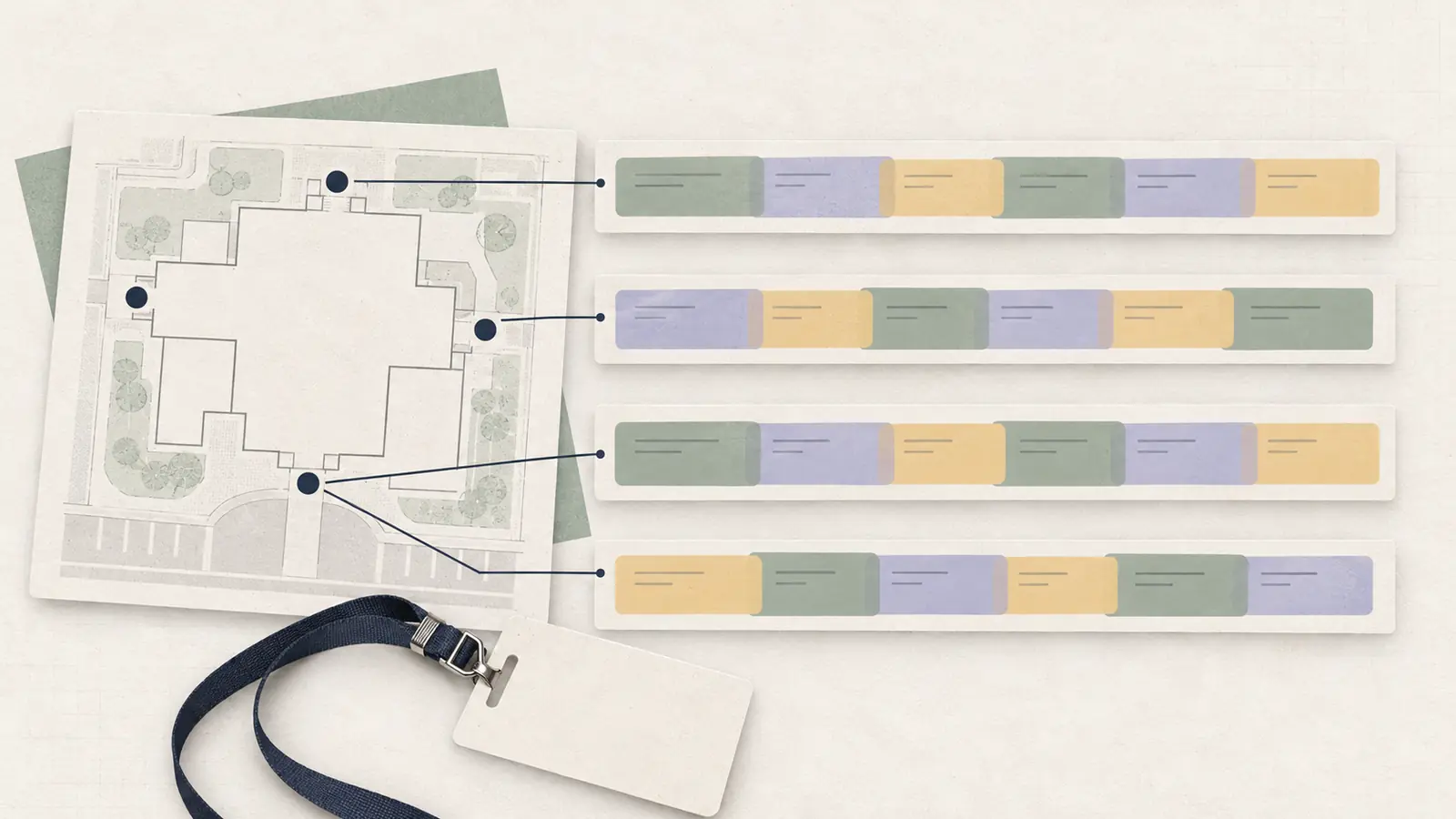
A shift can be fully staffed on paper while a building entrance remains unattended. A guard might be assigned to a patrol at the same time another post needs continuous monitoring. An overnight replacement might arrive without the site access or training required to take over. The numbers on the roster may look adequate until the manager checks where each person will actually be working.
Security guard scheduling is the process of assigning eligible guards to specific posts, patrols, sites, and shift periods. A usable schedule includes handoffs, relief for breaks, client instructions, and a contingency for absences. The U.S. Bureau of Labor Statistics describes guard work across offices, industrial properties, retail locations, and other settings, with rotating and overnight shifts common in the occupation.
What Does a Security Guard Schedule Need to Show?
A security roster should answer who covers which post, where, during what hours, and under whose instructions. Include the guard’s name, work location, assigned function, start and end time, supervisor, required eligibility, and the person expected to relieve or take over the assignment.
Fixed posts may include access-control desks, gates, monitored entrances, or observation stations. These can require continuous presence even if visitor traffic is low. Patrol assignments involve a route or periodic checks of a defined area. Patrol time must be planned around required fixed-post coverage rather than added as an invisible extra duty.
Different contracts may specify different tasks, response procedures, uniforms, equipment, and reporting obligations. Check the actual client agreement and applicable licensing or registration requirements before treating a guard as interchangeable across sites. A roster that meets total labor-hours demand can still fail one site’s contractual coverage requirements.
Calculate Required Guard Hours Before Assigning People
Start with each post’s coverage window. A post requiring one guard 24 hours a day, seven days a week needs 168 guard-post hours each week before any separate relief or overlap requirement. With three nonoverlapping eight-hour shifts per day, that is 21 assigned shifts per week for one always-covered post.
Next, add any additional posts. A hypothetical weekday visitor desk requiring one guard from 9 a.m. to 5 p.m. needs five eight-hour shifts, or 40 more post-hours. Across both posts the operation requires 208 post-hours and 26 eight-hour shift assignments each week.
Example weekly security post coverage
| Post | Coverage window | 8-hour shifts/week | Post-hours/week |
|---|---|---|---|
| Main gate | 24 hours, 7 days | 21 | 168 |
| Visitor desk | Mon-Fri, 9 a.m.-5 p.m. | 5 | 40 |
| Total | Two distinct posts | 26 | 208 |
This original example assumes every shift has one fully qualified guard and that post coverage is continuous. The 24-hour site has three eight-hour blocks: 7 a.m. to 3 p.m., 3 p.m. to 11 p.m., and 11 p.m. to 7 a.m. the next day. The weekday desk has one 9 a.m. to 5 p.m. assignment Monday through Friday.
Five guards working 40 hours each would provide at most 200 scheduled hours, leaving an eight-hour deficit before accounting for breaks, training, vacation, absences, or eligibility restrictions. Dividing 208 by 40 gives 5.2 theoretical full-time-equivalent 40-hour workloads. It does not establish that six particular employees can cover every shift, because qualifications, rest intervals, time off, and the workweek distribution may create further constraints.
To validate the roster, draw a 168-hour timeline. For each required post and interval, count the qualified guards assigned there. Every required interval must have its own coverage. If a guard is assigned to simultaneous posts, count that person once unless the duties truly allow coverage of both under the actual security plan.
What the 5.2 FTE figure excludes: Dividing 208 required post-hours by a hypothetical 40-hour workweek gives only the arithmetic floor for this example. It does not mean six guards can cover the contract. Coverage still depends on post-specific credentials, which shifts each person can actually work, paid and unpaid breaks, sickness, leave, training, handover time, rest, and overtime rules. A complete roster may require additional eligible people or funded relief.
How many guards do you need?
Enter your round-the-clock posts and any weekday-only posts. See the total guard hours per week and the fewest guards you would need, before cover for breaks, leave and training.
Your calculation
This is a planning estimate. Before you publish a real schedule, check who is available, their skills, and any rules that apply.
How this calculation works
Total hours = 24/7 posts × 168 hours, plus weekday posts × days × hours, plus extra cover hours. Divide by each guard's weekly hours for a rough headcount.
Plan Fixed Posts, Patrols, and Relief Separately
First mark assignments that require uninterrupted coverage. Then reserve time for patrols, breaks, briefings, access checks, incident reports, and handovers. An on-duty guard cannot be assumed to leave an entrance for a patrol unless the post’s operating plan permits it.
A relief guard may be shared among posts if geography, travel time, equipment, and contract terms allow. Document the actual relief window. If three fixed posts all require a 30-minute break cover at noon, one relief guard cannot cover all three simultaneously.
Practical rule: a guard assigned to a different post is no longer available to provide the original post’s required continuous coverage. Treat relief as a coverage requirement with its own time interval and assigned owner.
How to Build a Security Guard Work Schedule
1. Inventory posts and site requirements. Write down fixed-post hours, patrol frequency, monitoring duties, response obligations, supervisor coverage, site instructions, and the credentials or training required.
2. Convert each requirement to timed assignments. Allocate guard hours to the exact post. Keep necessary briefing, break, and handoff coverage separate when those tasks reduce time available for the primary assignment.
3. Check qualified guard availability. Use current employee availability, scheduled leave, approved work restrictions, site access, and any relevant guard-registration requirements.
4. Build shifts across the complete week. Place the hardest-to-fill posts first. Review overnight boundaries and split assignments across different client locations. A shift starting at 11 p.m. finishes on the following calendar day.
5. Validate the entire coverage map. Search for gaps, overlapping assignments, unsupported breaks, excessive hours, and changes that leave a post without a qualified guard.
6. Publish one approved roster. Guards need clear reporting times, locations, instructions for replacing an absent colleague, and a dependable way to identify the current version.
The general shift scheduling guide explains the full process of publishing and maintaining an employee roster.
8-Hour and 12-Hour Security Shift Patterns
An eight-hour schedule can split a continuous post into three blocks each day. For example, 7 a.m. to 3 p.m., 3 p.m. to 11 p.m., and 11 p.m. to 7 a.m. That provides 21 shifts weekly for one 24/7 position. Managers still need to distribute those assignments among available guards, check their actual workweeks, and handle relief.
A 12-hour schedule uses two shift blocks daily and 14 shifts weekly per continuous post. A four-team rotation may average 42 scheduled hours per crew weekly across a full cycle when every team covers the same number of shifts. Some individual weeks will be heavier. Such patterns need a separate assessment of fatigue, handoff requirements, overtime exposure, and whether the full cycle gives adequate recovery time.
The best structure depends on site access, client obligations, available personnel, and employee recovery. A rotating shift schedule can distribute weekends and night duties when the full pattern has been validated. A simple fixed post may be easier to administer where personnel and contract hours are stable.
Check Rest, Fatigue, and Overtime Exposure
Security work may involve extended monitoring, isolated overnight assignments, and irregular schedules. OSHA’s worker fatigue guidance associates demanding shift patterns with fatigue concerns. OSHA’s prevention guidance recommends reviewing staffing, workload, unplanned absences, and opportunities for rest.
Evaluate how a guard’s shifts line up in real time. If a person finishes at 7 a.m., their next planned start must be checked against any required minimum rest, travel, and realistic recovery time. A schedule with sufficient headcount can still create a fatigue risk if the same worker repeatedly covers a late shift followed by an early start.
For employees covered by federal overtime rules, the U.S. Department of Labor’s FLSA guidance explains the general overtime requirement when nonexempt employees work more than 40 hours in a workweek. Other requirements may apply under state or local law, employment agreements, or a relevant industry arrangement. Calculate workweek hours from actual hours worked, including compensable handovers, rather than assuming that all scheduled blocks are identical.
Security Licensing, Training, and Post Eligibility
A guard being available is only the first qualification check. Post eligibility can also depend on the location’s license or registration requirements, client-specific training, equipment permissions, access controls, and any restrictions on armed or specialist assignments. These details vary by jurisdiction and contract.
Create a post eligibility matrix listing each site or post, mandatory credentials, induction requirements, skills, and permitted equipment. Keep credential status and any expiration date current using authoritative records. Do not automatically release a guard into a restricted position because the scheduler sees a vacant shift.
When a colleague calls out, the eligible replacement pool should be filtered by the post requirements before anyone is offered or assigned the shift. If nobody qualifies, escalate to an authorized manager and the client in accordance with the agreed contingency procedure.
Handle Security Call-Outs and Open Shifts
A call-out at a continuous post has a defined consequence: unless another qualified guard takes over, the post’s coverage plan will fail. Start with the location and time at risk, then check whether trained relief personnel can cover the gap.
First, identify the exact uncovered interval. A guard who can arrive at midnight may cover part of an overnight assignment but cannot fill an unattended gap from 11 p.m. to midnight.
Next, check suitable replacements. Include location access, required credentials, actual travel time, shift conflicts, approved leave, and work-hour implications. The nearest guard may lack the post-specific training or be committed to another site.
Then, approve and communicate. Identify the accountable supervisor. Record the replacement and expected handoff time, update the approved roster, and notify the affected guards and client contacts according to the incident procedure.
Open shifts can provide a controlled way to solicit eligible volunteers, while a shift swap may be appropriate when both guards are qualified for the duties they are exchanging. An agreement between two employees is not the completed approval for a restricted post.
Plan Incident Escalation and Shift Handoffs
An effective security handoff communicates active access restrictions, unresolved alarms, incident reports, visitors or contractors requiring follow-up, equipment faults, and any deviations from the normal patrol or monitoring plan. Decide which information must be documented and who receives it under the contract.
Use a short handoff checklist at each transition. It should identify the outgoing and incoming guard, posts transferred, outstanding matters, equipment status, and the supervisor contacted if the incoming guard is late. Where overlap is required, budget both employees’ time into the roster.
For tasks involving emergency response, confirm the site’s emergency action plan and employee responsibilities rather than assuming the roster itself provides a safe response procedure. OSHA’s emergency action plan requirements apply in the situations described by the standard. The applicable site plan may impose additional communications and training duties.
Multi-Site Security Scheduling
Organizations covering several clients need a master view of guard assignments, plus site-specific details. A guard who ends a shift at one facility at 6 p.m. cannot begin a second assignment across town at the same instant. Include travel and reporting procedures in the schedule.
For every proposed reassignment, check the receiving post, the post being vacated, credential eligibility, travel time, and supervisor approval. A relief guard who temporarily covers Site A may no longer be available to resolve an unrelated issue at Site B. Record those consequences before approving the change.
Site notes also matter. One customer may require access control throughout the day, another may require mobile patrols at set intervals, and a third may have equipment-specific procedures. The scheduler should distinguish those contract requirements from optional activities that can be moved within the shift.
A Weekly Security Scheduling Audit
Before publication, use this compact review sequence:
• Post coverage: Does every required time interval have the correct number of assigned, qualified guards?
• Relief: Are breaks, patrols, briefings, and supervisor absences accounted for?
• Eligibility: Have registration, site access, training, and equipment requirements been confirmed?
• Time: Are shifts, cross-midnight transitions, travel, total workweek hours, and fatigue considerations workable?
• Change control: Are there named backups and one agreed approval route for emergencies?
• Communication: Can each guard find the current site instructions and approved schedule?
• Reporting: Is there an accountable owner for handoffs, incidents, and unresolved access issues?
After each week, compare planned guard-post coverage with actual attendance, overtime, uncovered intervals, incident-driven changes, and client issues. Distinguish a rare emergency from a repeating staffing deficit before changing the baseline roster.
When Security Scheduling Software Helps
A single fixed post with a stable roster may be manageable in a shared spreadsheet. Coordinating several posts, licenses, patrols, relief guards, and last-minute coverage across clients adds more room for double-bookings and outdated instructions.
If a manager needs more control, security scheduling software can be evaluated for shift assignments, post eligibility, multi-site views, change approvals, and employee communications. A product’s calendar alone does not establish that it satisfies the actual service contract or local guard licensing requirements.
Security Guard Scheduling FAQs
How many guards do you need to cover a 24/7 post?
One continuously staffed position requires 168 guard-post hours per seven-day week. With eight-hour shifts, that translates to 21 shift slots. The number of individuals needed depends on their availability, credentials, actual hours, relief arrangements, and legally or contractually required rest.
Can guards change shifts with each other?
A proposed exchange can work when each employee is qualified for the other’s post and the change passes approval, hours, rest, and coverage checks. The responsible supervisor should update the official roster before the guards act on it.
How should managers schedule patrols?
List patrol routes, required frequencies, estimated travel times, and any response duties. Check that fixed posts retain their required coverage while a guard is away. Where necessary, assign a separate patrol guard or qualified relief.
What if a replacement does not arrive?
Follow the agreed site escalation and contingency plan immediately. Confirm who is currently providing coverage, contact approved relief personnel, and record the event. Do not assume that asking the outgoing guard to stay indefinitely is a safe or lawful standard solution.
The Bottom Line
Start with the posts the contract requires and the hours each one must be staffed. Check every interval against an available, eligible guard, including patrol and break coverage. A good security roster gives supervisors a reliable way to manage absences while preserving the site’s actual coverage requirements.
Sources and Further Reading
U.S. Bureau of Labor Statistics: Security Guards and Gambling Surveillance Officers
OSHA: Long Work Hours, Irregular Shifts, and Worker Fatigue
OSHA: Worker Fatigue Prevention
OSHA: Emergency Action Plans, 29 CFR 1910.38
U.S. Department of Labor: Overtime Pay Requirements